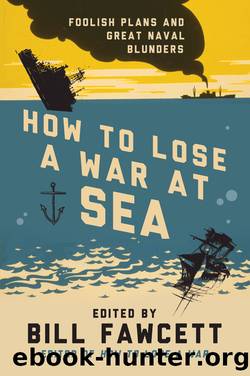
How to Lose a War at Sea by Bill Fawcett
Author:Bill Fawcett
Language: eng
Format: epub
Publisher: HarperCollins
Published: 2013-10-01T00:00:00+00:00
Orders
On July 4 the American ships in the convoy all ran up brand-new oversize flags, in honor of Independence Day; the sight cheered their crews and impressed the British who observed the gesture from their own ships. Later that day, however, the Naval War Staff met in London and arrived at what would prove to be a catastrophic decision, authorized by First Sea Lord Pound, with the full agreement of every member of his staff. Fearing that the German surface ships would strike at any moment, the staff on dry land, far from the action, sent three orders between 9:11 and 9:30 P.M., orders that shocked and appalled Admiral Hamilton and Commander Broome.
All of the orders were prefaced with a âMost Immediateâ tag, meaning that they were high priority. The first commanded âCruiser force to withdraw to the west at high speed.â Twelve minutes later came an alarm about the threat from surface ships, with instructions to disperse the convoy, with each ship heading for a Russian port on its own, without benefit of convoy or escort. Shortly thereafter, the unambiguous command âConvoy is to scatterâ came over the airways.
This short flurry of communications allowed the German surface fleet to inflict more damage on the Allies than at any other period during the warâand all without firing a shot or even appearing on the horizon! For, unknown to the Admiralty, the mighty ships had already been recalled. Fearing interference from an Allied aircraft carrier, Hitler declined to risk Tirpitz in battle. Even more ignominiously, Scheer had run aground right off Narvik and was incapable of operating against the convoy.
In the convoy escorts, both Hamilton and Broome were taken aback. They had been brimming with confidence, having beaten off the air attacks with minimal damage, and had yet to suffer a torpedo attack from the U-boats known to be in the vicinity. With Broomeâs tight screen of destroyers and other anti-submarine vessels, the officers on the scene felt that they had a very good chance of pushing through all the way to Archangel. In the words of one officer aboard an escorting warship, âBy simply shifting her anchorage the Tirpitz had done what massed U-boats and aircraft failed to do: she had broken the cohesion of the convoy.â
The results of the plan were clear to everyone aboard the warships and merchantmen alike: without the tight formation of the convoy, and the presence of the escorts, the cargo ships would be helpless against the obvious threats of German aircraft and U-boats. Emotions verged on rage among the crews and captains of the warships as they were confronted with the confounding change, but they had no choice but to obey the order. As an officer aboard the heavy cruiser Norfolk recorded later: âThe effect on the shipâs company was devastating. . . . We abandoned the convoy. The ship was in a turmoil, everyone was boiling, and the Master at Arms told me he had never known such strong feelings before. . . .
Download
This site does not store any files on its server. We only index and link to content provided by other sites. Please contact the content providers to delete copyright contents if any and email us, we'll remove relevant links or contents immediately.
| Africa | Americas |
| Arctic & Antarctica | Asia |
| Australia & Oceania | Europe |
| Middle East | Russia |
| United States | World |
| Ancient Civilizations | Military |
| Historical Study & Educational Resources |
The Dawn of Everything by David Graeber & David Wengrow(1707)
The Bomber Mafia by Malcolm Gladwell(1623)
Facing the Mountain by Daniel James Brown(1553)
Submerged Prehistory by Benjamin Jonathan; & Clive Bonsall & Catriona Pickard & Anders Fischer(1455)
Wandering in Strange Lands by Morgan Jerkins(1430)
Tip Top by Bill James(1416)
Driving While Brown: Sheriff Joe Arpaio Versus the Latino Resistance by Terry Greene Sterling & Jude Joffe-Block(1376)
Red Roulette : An Insider's Story of Wealth, Power, Corruption, and Vengeance in Today's China (9781982156176) by Shum Desmond(1359)
Evil Geniuses: The Unmaking of America: A Recent History by Kurt Andersen(1354)
The Way of Fire and Ice: The Living Tradition of Norse Paganism by Ryan Smith(1336)
American Kompromat by Craig Unger(1315)
F*cking History by The Captain(1304)
It Was All a Lie by Stuart Stevens;(1300)
American Dreams by Unknown(1286)
Treasure Islands: Tax Havens and the Men who Stole the World by Nicholas Shaxson(1273)
Evil Geniuses by Kurt Andersen(1257)
White House Inc. by Dan Alexander(1212)
The First Conspiracy by Brad Meltzer & Josh Mensch(1174)
The Fifteen Biggest Lies about the Economy: And Everything Else the Right Doesn't Want You to Know about Taxes, Jobs, and Corporate America by Joshua Holland(1126)
